Listen, little one.
Come here. Sit up. Wipe your face.
Sit closer. Your dog can come too - yes, right there, tuck him under your arm. What is it we call him? Kuai! The quick one, good. He's a good dog. Anyone can see that.
You're shaking. I know why. I heard the commotion in the courtyard - I know what the zhu said about the tomb, about what must be buried with your uncle, about "a dog of the household."
I know the fear that puts in a boy's heart.
So listen to me now, and before you start shaking again, you'll hear a story…
There was once a dog in this family, long before you were born. Two hundred seasons, maybe. Yes! A little ratter named Shu.
His name meant catch, and he did. Ha! He did: rats in the stores, bold ones, fast ones, the kind that ruin a winter's grains if you let them. But Shu didn't let them - he was small, quick, sharp. He was never hungry a single day in his life, which was a rare miracle then, for in those days, yes the old old days when your old grandfather was unwrinkly and smooth like you, life could be a hungry game, and cold.
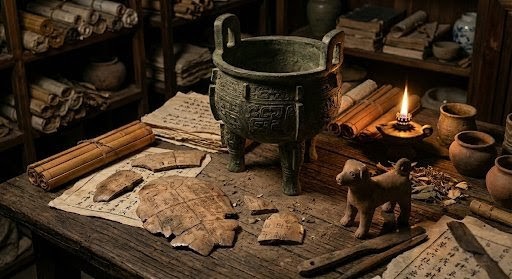
But Shu was cunning enough to be born lucky, and belonged to this house - our house with the oracle bones, where grain rose in tall jars and pork hung from rafters, dripping salt and fat. That's right boy, like now!
The dog followed a boy named Wu. That's right, boy: your grandfather. Wu, fifth son. My brothers learned war, or numbers, or the dealings of men. I was to inherit nothing, gain nothing, expect nothing, in the way of shadows and younger sons, as you know.
The house? This farm? How did it come to me? Ha! Let us say that brothers who learn war are often found out by it; that numbers are not so safe and boring when they count gold, and the dealings of men… well we know they are the trickiest of all.
Anyway boy you're getting me turned around in my story - the bones!
I spent my days in the divination room, scratching the questions into turtle shell, heating bronze rods over coals, watching cracks form like lightning captured in stone. Your time will come to learn this. Busy hands and solitude make for lonely work sometimes.
I would talk to Shu constantly when I could.
Shu understood none of the words and all of the loneliness. At night he slept across my feet. On cold nights, against my side. When I would lie awake and worry as fifth sons do, Shu's breathing took me back to my rest.
When my father died - your great-grandfather - the house filled with smoke and shouting and the sound of the zhu and their ordering of things. You know that noise now too.
I cried into Shu's fur until my eyes hurt. Oh don't look down boy, I'm old enough that I've outlived my shame. The little dog lay there, still as river stone, letting the salt soak his ruff and not buckling when I leaned on him. Good dogs can do that, even the little ratters.
On the fourth day - always the fourth - men came with a rope. A mean faced old zhu said a fine dog of the household must go into the tomb.
I knew then that they meant to take my Shu. Of course they did! He was the best of dogs. Strong jaw, quick, obedient and canny. They always want the best.
Shu didn't understand, of course. He saw the men and ran to their feet. Saw their rope and, since he was sometimes tethered to bring back a rat from a small place, was not afraid. His tail was still and uncertain, but he trusted me and the men of the house and that hurt my heart all the more.
Now have you noticed how a hawk is small compared with the vastness of a sky? But when she cries, she seems to fill all the sky and to own it with her presence? Well that was the kind of tiny woman that was my grandmother. She would be your great-great-grandmother as they say.
She had been at the well, or the stores- I don't remember. But I remember the sound of her feet on the stones, fast and hard, and the way the servants scattered and the courtyard went quiet before she even spoke.
Grandmother stepped between us and the zhu. She was tiny, yes, but her will was a wall of stone.
"No," she said. "Not this one."
They argued.
The tomb needs a dog.
The ancestors require it.
Tradition.
Gesture.
Blood.
Then grandmother said, and I remember this exactly:
"You want the ratter? The good one? While the grain stores have holes chewed through them? Take the biter from the kennels! Or a rabbit! Or take nothing. The ancestors won't know the difference. They want an offering, but they won't count the teeth."
And then - this part matters - she looked at me. At Shu. At the rope.
Her voice dropped cold but gentle, like the courtyard in snow.
"My grandson has already lost his father. You will not take his dog."
The men hesitated. Looked toward the house. Looked at the rope. Looked at Shu.
Shu pressed his head into my hand. Didn't move.
In the end they took the old biting dog, the one who snarled at servants. She went quiet, tail low, but she didn't fight. Maybe she knew? Maybe she understood fate? I don't know and the bones have never told me.
That night I held Shu too tight. He didn't complain. He never did. I could feel his breathing against mine, steadying me.
His heart was a drum that said: here, here, here.
And outside the drums of the burial beat on, until the smoke cleared and the voices stopped.
My little Shu slept across my feet until I was grown. He was always warm, full, with nothing taken from him that he didn't give freely.
And here is what I learned from that night, the thing I want you to hold close:
The ancestors demand much, yes.
To outrage them will put a curse on you, it's true.
But they do not know one dog from another.
The tomb is blind.
I know this because my life has been a garden of blessings - like you little one. I have had as much happiness as I could hold, and Shu had a fine life for a dog. No curse found us. Soon when I meet the ancestors, I'll look them in the eye.
And tomorrow I will dig up that stray we killed last winter when it took our hens. The bones are still there under the elm. We will wrap it, bind it, make it look proper. These zhu will not look closely. Not in this house. The ancestors will nod at our effort.
And your Shu - I'm sorry! Kuai? This warm little creature trembling on your lap - he will stay.
He will sleep by your feet tonight.
He will grow old in this house.
He will never know a rope around his neck for anything but ratting down a hole.
Do you hear me boy?
He's a good dog.
And good dogs stay.
Come now.
Breathe with him.
Match his pace.
Slow. Steady.
Yes. There.
The drums outside are only for the dead.
You, and your dog -
you belong to the living.