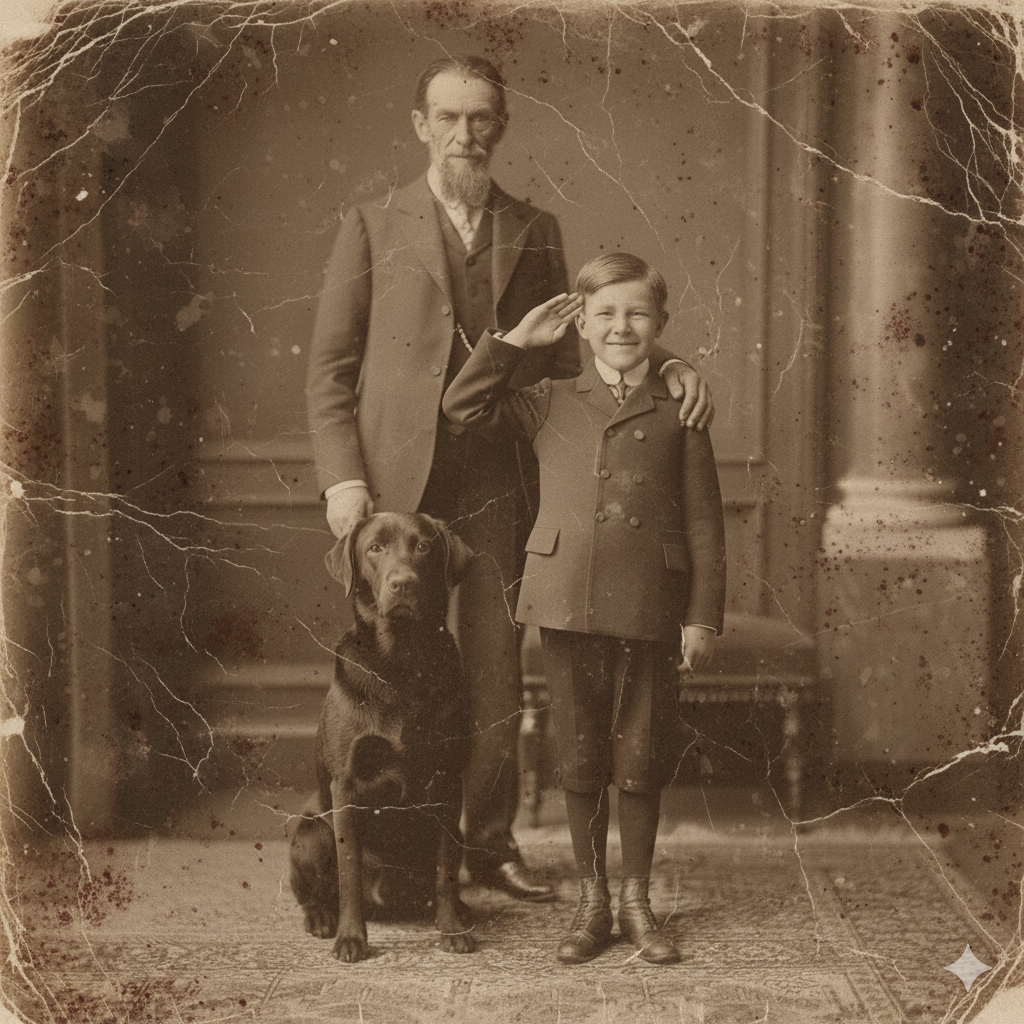
1898: Arrival
The Labrador is black as the Traunsee at midnight, a gift from English cousins who understand how good breeding shows itself. Form ist Schicksal. He's eight months old when the Graf von Hochberg finds him sitting perfectly at attention in the marble entrance hall, trained throughout the long journey by the junior kennelmaster- who takes a meal below stairs before departing for the return train out of the Westbahnhof.
The Graf names the dog Kastor after the constellation. The mortal twin. Kastor learns it means you, means come, means attend to me now. This is sufficient.
His world is the palais on Herrengasse. Four floors of marble and gilt, rooms that echo, servants who move like phantoms. His place is at the Graf's side. Sitting room, study, dining room (at first only when there are no formal guests, later always), bedroom at night on a Persian rug worth enough to feed a Brigittenau family for a year.
Kastor learns the rhythm of the Graf's life the way his littermates learn the shoot: breakfast at eight (offcuts of raw meat and offal, smelling of iron and life and though butcher's rejects, still better than families just half a mile away can afford for a feast day), the Graf reading newspapers while Kastor lies at his feet. Correspondence in the study. Luncheon. Afternoon walk through the Stadtpark, Kastor heeling perfectly, never pulling, the embodiment of breeding and discipline. Dinner. Evening at the opera or the salon, Kastor waiting in the carriage or, when the gathering is intimate, lying beneath the piano while someone plays Mahler.
He's not a pet, exactly. A presence. A necessary accessory of rank. In Kastor one can see the family's taste and restraint made glorious jet black flesh. Striding beside the Graf, Kastor seems to take on his bearing until one cannot be sure to whom the sense of dignity, of endurance, of continuity belongs and on whom it is conferred by association.
1900: Salon
The Graf hosts gatherings twice monthly. Intellectuals, artists, the occasional journalist bold enough to enter this world of old money and older names. Kastor sits by the fireplace, watching. Head still, eyes ranging.
The conversations move like sparring: Freud's theories (scandalous, fascinating), the Emperor's failing health (whispered), the labour strikes (dismissed with languid waves of cigarettes), the Czechs and Hungarians demanding autonomy (machinations of democracy seem base, almost bodily).
A young painter attends once, intense eyes, bad suit, worse manners. He talks in a voice too loud for the room about art, about purity, about the degeneracy of modern Vienna. The Graf suggests he take his jacket downstairs for Gretel to look at the torn cuff… the servants take the hint and the man doesn't find his way back. "The youth are overwrought…" the Graf says later to Kastor, "They will surely break everything beautiful."
Kastor watches the guests come and go. Watches the alliances form and break. Watches the mistress (not the nervous Gräfin, who lives in the country house, presumably hiding under dust sheets along with her own family's furniture) arrive through the servants' entrance and leave the same way around dawn.
Kastor is too busy to watch the Graf's son, the Young Graf, argue with his father over the little grandson's future. Gymnasium or Militärakademie? Max is five and squeals deliciously in ways that loosen the young dog's decorum until dog and boy appear as a blur together in the hallways.
"Don't waste the boy shooting Serbs!" The Graf almost never raised his voice. "His life is barely begun!"
"He'd be fighting for the Empire!"
"Hah! Fighting for the empire…" The old man shook his head, gestured around the room at the wood panelling, the sombre drapes, lingering smoke. "For all of this? Or for the draughty Schlöss?" The Young Graf finds Max tangled with Kastor and drags him sleepily into the carriage. He does not return for months.
If the dog aches for his playmate, he remains resolute. He does not understand secrets, or empire, or the tide swelling around them. He understands duty. Even had the choice been his, he would have chosen the same: to stay, alert and silent.
1905: Diagnosis
The Graf receives news from his physician in the study. Kastor is by the desk, as always. The doctor's voice is careful, clinical: six months, perhaps a year with care, the growth is inoperable, best to set affairs in order. "Es tut mir leid, Herr Graf…" he says at the door. "Perhaps time to leave the city for the comfort of the countryside?"
The Graf thanks him. Shows him out. Returns to the study. Sits.
Kastor emerges from under the desk. Puts his head on the Graf's knee.
The Graf's hand comes down, rests on the broad skull. They sit like that for half an hour. The Graf's hand shakes slightly, and Kastor can smell the fear, sharp and acrid beneath the cologne.
"Five more years," the Graf says eventually. "That's what they say your people get, if you're lucky and fed well. And you most certainly are, aren't you, my boy? Perhaps it is I who should be Kastor, and you Pollux. If you come by immortality, do share just a little."
Kastor doesn't know that myth, but he understands when to be steady, which is to say: always.
From England, weeks later:
You're all welcome of course. Bring the hound and the boys!
The Graf looks around him for a moment, sighs, pats Kastor's head. A kind offer, but impossible. He folds it into his desk.
He does not tell the Young Graf when he next brings Max to visit. Kastor seems to recognise something in the specific ringing of the doorbell and leaps from the Persian rug and away down the hallway, a rare dereliction of duty overlooked by the smiling Graf.
Max embraces Kastor as an old friend, and the two set about reenacting the moving picture he has seen in Paris. Max plays the brave lunar explorer with umbrella raised against his foe; Kastor the dastardly moon-imp, ready to burst into dust in defeat.
While sounds of their play fill the sitting room, the Young Graf, electric with talk of kronen, unrolls maps across his father's desk. Never a visit wasted these days, thinks the Graf.
"A spur through the Sandžak, Father. The Sultan's amenable, the terrain's been surveyed." The Young Graf fizzes with the possibilities. The old Graf is pensive.
"This railway is… a certainty? The returns will secure things for Maximilian?" Not to mention the Gräfin's ruinous treatments in Basel, the many rooves and re-roofings of the Schlöss, appearances.
The Graf signs the papers just as moon-imp and explorer crash into his study. Moon men and railways to nowhere, he thinks as he ruffles them both. I have outlived sense, at least.
1908: Annexation
Außenminister Aehrenthal, Serbs and Ottomans be damned, throws the Empire's threadbare cloak over Bosnia-Herzegovina. In public, the Graf toasts the boldness, as patriotism dictates. In private conversations, sage heads shake. The parties grow louder, almost feverish. The gaiety becomes brittle, laughter sharp at the edges as if the Empire could dance right over the crack opening beneath it.
The Graf defies the prognosis. The growth is slow, painful, managed with morphine and grit. He grows thinner as Kastor grows broader, settles into his full adult weight, ninety pounds of muscle and noble bearing. He is ten years old and in his late prime. Still strong, still healthy, still beautiful. Guests pet him, admire him, comment on his longevity. "What do you feed him?" they ask.
"Raw meat," the Graf says. "And purpose. My aide de camp!" The irony is not lost on a younger visitor who whispers to their companion: "Purpose! But what is a Graf for, now? Least of all one already dying."
The parties now include younger people, brasher, louder. They drink champagne from bottles instead of coupes. They dance to music the older guests find unseemly: ragtime, jazz, rhythms imported from America. They talk about revolution like it's fashionable, like it's a game.
Fürst Waldstein attends less frequently now, like many of the old guard. When he does come, his waistcoat is last year's, so too are his anecdotes. His hand shakes reaching for the wine. No one mentions it in his presence. Over leveraged, they say. The Graf winces as the Fürst leaves early one evening, gripping arms and cabinetry to steady his exit. The young vultures are watching. That is what happens when you stop.
The parties continue.
One night, very late, two young men kiss in the library. Kastor watches from his spot by the fire. The Graf, entering for a book, also watches. Pauses. The young men freeze, terrified. The law requires ruin.
The Graf looks at them for a long moment. "If you're going to do that," he says finally, reaching for the lamp, "at least do it in the dark." He takes his book and leaves them in darkness. Kastor follows. Behind, one of the young men laughs: relief, gratitude, scandal averted.
Later, the Graf tells Kastor: "Ach, let them have their fun. The world is ending, you know. Soon there will be only we immortals."
1911: The Heir
The parties stop abruptly after a halting plea from the housekeeper. Deeply ashamed, she sends Gretel the maid. "Verzeihen Sie, Herr Graf…" the girl's eyes on the floor before her, "with the present funds it is impossible…" No matter, they were becoming as tiring for Kastor (grey at the muzzle and improbably upright at thirteen) as they were for his master, slow now with pain and morphine.
Max visits during a break from the Neustadt academy- sixteen years old, serious, slight. The Young Graf is away, always away, and the marriage is troubled, and the boy has been shuttled between houses and dorms like luggage.
The boy spends a week at the palais. Kastor follows everywhere, ignoring the groan of his hips. The boy sleeps with his hand buried in the dog's fur. Tells Kastor things he can't tell the Graf: how he cannot bear his parents, how he dreads both the precise cuts of his mother's tongue and the slower sickness of his father's silence. How he dreads all of it: the cold rooms of home, the halls of the academy and the world outside. Kastor hears the base notes beneath the words and leans his weight against the boy. When he brings the Graf's stolen slipper, tail thumping like a puppy, the boy seems to lighten.
It is during this week that the Young Graf wires from Paris with the news.
SANDZAK VENTURE CONCLUDED UNFAVORABLY STOP OTTOMAN COMPLICATIONS STOP WILL EXPLAIN WHEN NEXT IN VIENNA STOP
Folding the telegram quickly and tucking it into his desk drawer, the Graf sighs, looks around the room. Let us hope Herr Steiner can find some wealthy Americans with a taste for the old world, he thinks. Two more Caravaggios in the attic and a house on borrowed time.
When the week ends, the boy sits at the foot of the staircase, he and Kastor as inseparable as the celestial twins. The Graf clears his throat from the landing. "He'll be here when you visit again."
The boy returns twice more before he graduates Neustadt and is gazetted to the cavalry. When the Kommandant writes to his old friend the Graf, he tells him:
…His Excellency Herr Graf Maximilian rides as well as any, but must- will- harden if he is to inspire his men to follow.
The Graf sighs and looks to Kastor. "The world has enough hard edges, eh old man…"
1914: Fracture
The Archduke is dead. Sarajevo, pistol shots, everything accelerates.
DEAREST COUSIN STOP BORDERS CLOSING STOP URGE YOU COME NOW STOP ROOMS READY ALL ARRANGEMENTS MADE STOP HOUSEHOLD AND HOUND EXPECTED STOP
The Graf smiles thinly and shakes his head, says to the dog, "The rain there is no good for our old bones." Thinks: if I must be a relic in an attic, at least let the attic be my own. A Graf, like a good dog, must stay. He folds the telegram, feeds it to the fire. Kastor watches the paper curl and blacken.
The Graf is seventy-four, dying too slowly from something meant to kill him a decade ago. The palais has contracted to bedroom, study and endless dark corridors. Fitfully, when the morphine fog allows, the Graf reads the papers and a thin thread of correspondence at his desk. The Young Graf, his own section of railroad both resilient and lucrative, is safe in Paris with his own mistress. Auf das Reich, you wily shit. Someone has to finance these wars.
The Gräfin, once more discharged from the sanatorium, brittle as ever, holds lonely court by Lake Geneva in the summerhouse of a dear childhood friend. Stipend, naturally, still required. Auf die Gesundheit, you rotten sow.
He remarks often to the old dog at his feet that the world seems to belong now to madmen.
Kastor, impossibly, inevitably, is sixteen. His hips ache, his eyes have clouded, his muzzle is more grey than black. But still he follows the Graf as he always has, and if he suffers, the only outward signs are the low whines of seeming shame when he messes on his old rug.
The servants have left, aside from Gretel the maid, and her brother. When taking him on, the Graf wearily asks if he is trained in service. The man holds his gaze like an Archduke and says, "I'm no servant, Herr Hochberg… but I will help out for pay. Take or leave." The Graf takes.
Gretel cooks what she knows, with what she can get hold of. Food is scarce for nobles, for dogs, for all. The raw meat is a memory. Kastor eats what Gretel, her brother and the Graf eat: bread, thin soup, once a week some chicken or game.
The Graf loses his appetite also, for visitors and correspondence. Herr Steiner having fled, the hired brother proves to have contacts of a kind in the art and antique world. A pair of belle époque candlesticks commissioned for the Graf's wedding day goes for a tenth of their value. The proceeds buy coal and wine and a few weeks' food for them all. And morphine. When the brother leaves what's left, minus his cut, on the Graf's desk, the Graf chuckles to Kastor, "Gesindel doesn't know there's a Caravaggio in the attic out of reach."
Kastor is hungry, often. His body is failing in the small ways that precede the large ones. But his job remains, so the body follows. When in the spring it is found that the roof has leaked all winter; when the musty contents are brought down by Gretel's brother as he patches the hole; when the philistine holds up the last, ruined, priceless, worthless Caravaggio and says balefully "No great loss… not even any titties"; when the Graf collapses into laughter from a well of absurdity so deep that it looks fit to snap him in two, turns his handkerchief red; the old dog sways to his feet, head to the Graf's side, eyes closed, breathes with him until they both steady.
Some weeks into the war, another letter arrives, pressed into Gretel's hand on the doorstep by a solemn young adjutant. The Graf reads the words of the Kommandant at his desk.
To His Excellency The Graf von Hochberg. My dearest friend Leopold, it is my painful duty to inform you that your grandson…
His hand drops to Kastor's head. Fingers, all bone, thread into fur, duller now than it was- sooty black threaded with ash.
... with exemplary courage, sabre raised in sight of the enemy's guns, at the head of his squadron. The glory of his sacrifice will be remembered with honour by his comrades and the Empire. With deepest respect…
Neither of them moves until the candles gutter out.
One morning the Graf doesn't get up. Kastor waits by the bed, patient. The morning ebbs. The Graf still hasn't moved. Kastor whines, softly.
No response.
Gretel finds them at noon: the Graf dead in bed, Kastor lying on the floor beside him, head on paws, waiting.
They try to coax Kastor away. He growls- the first time he's ever growled at a human. Eventually they leave him. He stays with the body for two days, until the undertakers come.
They're gentler than expected. One of them fought in the Balkans, knew the Young Graf vaguely in youth, respects the old nobility even as the world shakes it off. He kneels by Kastor, scratches his ears. "You're a good boy. You stayed with him. That's good."
Kastor allows himself to be led away. The job is finished. Duty done.
They don't know what to do with him. The estate is in chaos. The Gräfin claims rights, the mistress claims vows, lawyers circle like crows. Nobody wants a sixteen-year-old dog who can barely walk.
Gretel remembers him as a puppy and takes him home. Her brother's apartment is small, cold, nothing like the palais. "Kill the thing," says her brother. "Would be kinder." But she feeds him what she can, lays his old Persian rug by the stove despite its smell, talks to him while she darns and mends and waits for her own son to return from the front. He doesn't.
Kastor lives six more weeks. Just long enough to see autumn arrive, the leaves turning, Vienna outside transforming from imperial capital to the thing it will be next. He dies in his sleep, in the warm spot by the stove. Gretel demands her brother sneak back to the empty house with her, half carrying and half dragging the body in the filthy old rug. This he agrees to because Gretel has taken and hidden his cache of Hochberg brooches and other jewellery, accrued by him with patience. In the courtyard they dig quickly, trying not to scrape the shovel and looking up every so often at the shuttered windows, but no ghosts appear. They roll the bundle into the hole. Kastor's grave is beneath the chestnut tree.
Epilogue
The house is subdivided, sold, eventually damaged in the next war. The palais makes way for apartments, the courtyard becomes a car park.
The Graf's papers are archived. Later a flood destroys them.
Maximilian von Hochberg is one name among dozens on a memorial visited yearly by cadets, for many years, and honoured with a municipal wreath.
The mistress marries wisely, twice.
The Gräfin dies in Switzerland. She has not spoken a word in the last ten years of her life.
The Young Graf survives the war and his first marriage, and emigrates to America grotesquely wealthy. He has a late second family and never speaks of the old country.
The stolen jewellery buys Gretel and her brother passage to Halifax, where he is stabbed to death in a bar brawl in their first winter. She works as a seamstress, sells a brooch or two every couple of years and lives almost to the next war.
A photograph in the attic of an English country house shows the Graf at his desk, a large black dog at his feet.
A mention in the diary of a celebrated pianist: "Met the Graf at his salon. Insufferable bore, magnificent dog."
A letter from the front, Jarosław 1914: "When this fighting is done, I should dearly like to visit grandfather and old Kastor."