The hall tonight is the world entire.
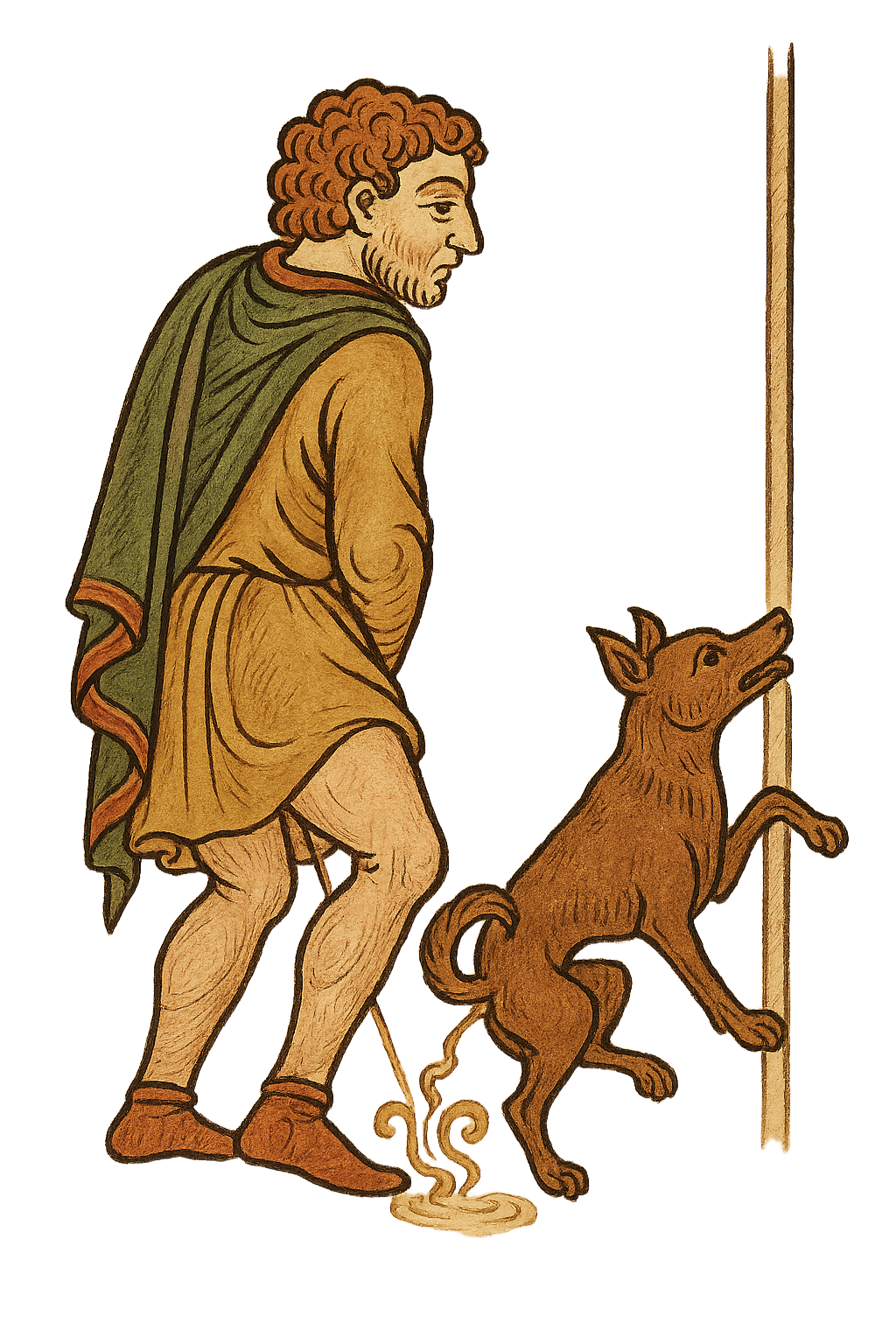
Outside it is dark enough to lose one's way between the gate and the door, cold enough in the blizzard to kill you while you find the way back. A wind keens through the forest, finding gaps in wool, gaps in stone. This winter night makes men check the thatch, count cords of firewood and pray - to Christ or the old gods or both - that enough was stored to see spring. Groans and curses chorus from within as the door opens, a hound lopes out, circles sniffing the ground. A man feels his way along the wall and squats, adding to the snowy dung pile as the dog steams his own patch of snow. This night, a man could freeze trying to make it to the midden. He finishes with a piss, sways back to the door and shoulders himself and the dog in toward the roar of flame and drunken voices.
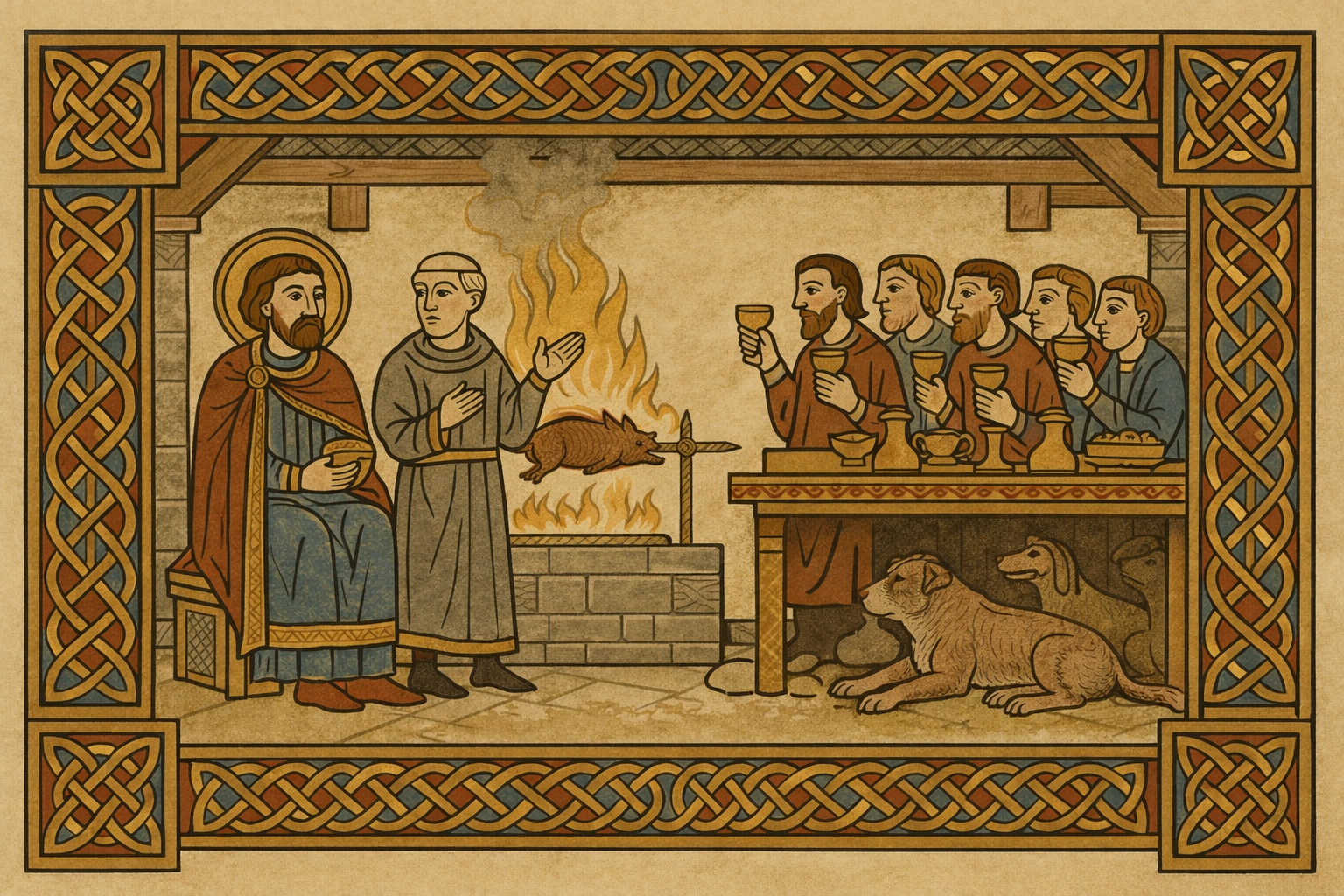
Inside are heat, bodies, smoke. A boar, dripping monstrous on the spit, turns to silken fat on the tongue, dripping down beards. Mead is thick and sweet, honey-dark in wooden bowls. The great hearth throws shadows up to the rafters where smoke hangs like river fog.
A tumult: a filthy rhyme, a fight about last year's hunt, a woman sings off-key but sincere, the harp player tries to tune over the noise, gives up, starts a drinking song instead.
The smell is of the meat-char and the tallow candles and the pine resin rubbed into the beams. There is wet wool drying too close to flame and there is the sweat of dogs and humans, and there is something sharper underneath - the smell of bodies warm and close and drunk and alive.
The feasting and the drinking are assured, but there is a muddle over the name of the thing. The eve before the mass of the holy infant, though most would still say Midwinter as their grandparents did. Or Yule, or the fire festival. Naming aside, the impulse is old and certain: it is the night to eat and drink and dance and warm cold hands with flesh, because tomorrow's promises can't be trusted. The dark and the ice claim too many victories and not everyone will see the spring, so to themselves, to whatever watches from the winter, those in the hall say we are here, now. These hearts beat yet.
At the high table, the thegn pours mead for his brother's ghost. A hard death - a long fever after the boar's tusk. The thegn raises his cup to the empty place at the bench, makes no speech. Tonight is for the living.
❧ ❧ ❧
The dogs sprawl full-bellied at the hearth. Bones cracked for marrow. Scraps of pork skin, crisp and salt-sharp. The day brought good hunting and better eating and this night has loosened the usually complex humans into simpler creatures of tongue and touch. Most of the dogs are young, active even in rest, ears swiveling at every sound - the door, the rafters, each other.
This one is older. Greying muzzle and scars telling tales across his face: boar tusk, wolf tooth, work done, violence survived. The last pair are inseparable, indistinguishable. To work is to hunt, to hunt is to kill, to kill is to eat and to earn the touch of the men at the high table.
He watches more than sleeps. Veteran. Knows the rhythms: hall and hunt, feast and famine, when to chase and when to wait.
Tonight is waiting. Inside the hall is life, outside is death. Blood shed here and now will bring no table scraps or ear scratches, so he watches, sighs.
❧ ❧ ❧
A year ago the thegn was less sure than many if he would see tonight's feast. To rule is to choose in public and this year's choices were narrow: a harvest thin in places, the fever stalking the valleys, the stores pitched against the unforgiving seasons. But he sits expansive in his glow of firelight, gold, and golden mead. The hall is full, the fire high, his people fed.
The old monk sits beside him, eating with the precise appreciation of a man who understands exactly how much labor went into getting meat to table. This is Bede of Jarrow, though most here know him as Father. He has a quiet, shrewd face and hands that have held quill more often than sword, but the hall grants space and stillness around him. He is here to see beyond the monastery walls as he prepares to release his opus into the world, but also to be seen, as per the wishes of the Abbot.
He has with him a younger man of his order. His earnest eyes and his melodic voice will do well to carry the Word. Bede noticed this, mentioned to the Abbot, and here they are. The young man's nervous fingers drum the table - he has prepared for weeks to give this, his first real sermon to an audience outside their cloistered world.
After the meal, before the drinking gets too serious, the test will be: can the doe eyes and the flute-voice help the boy land theology with this congregation who smell like their dogs and think with their bellies.
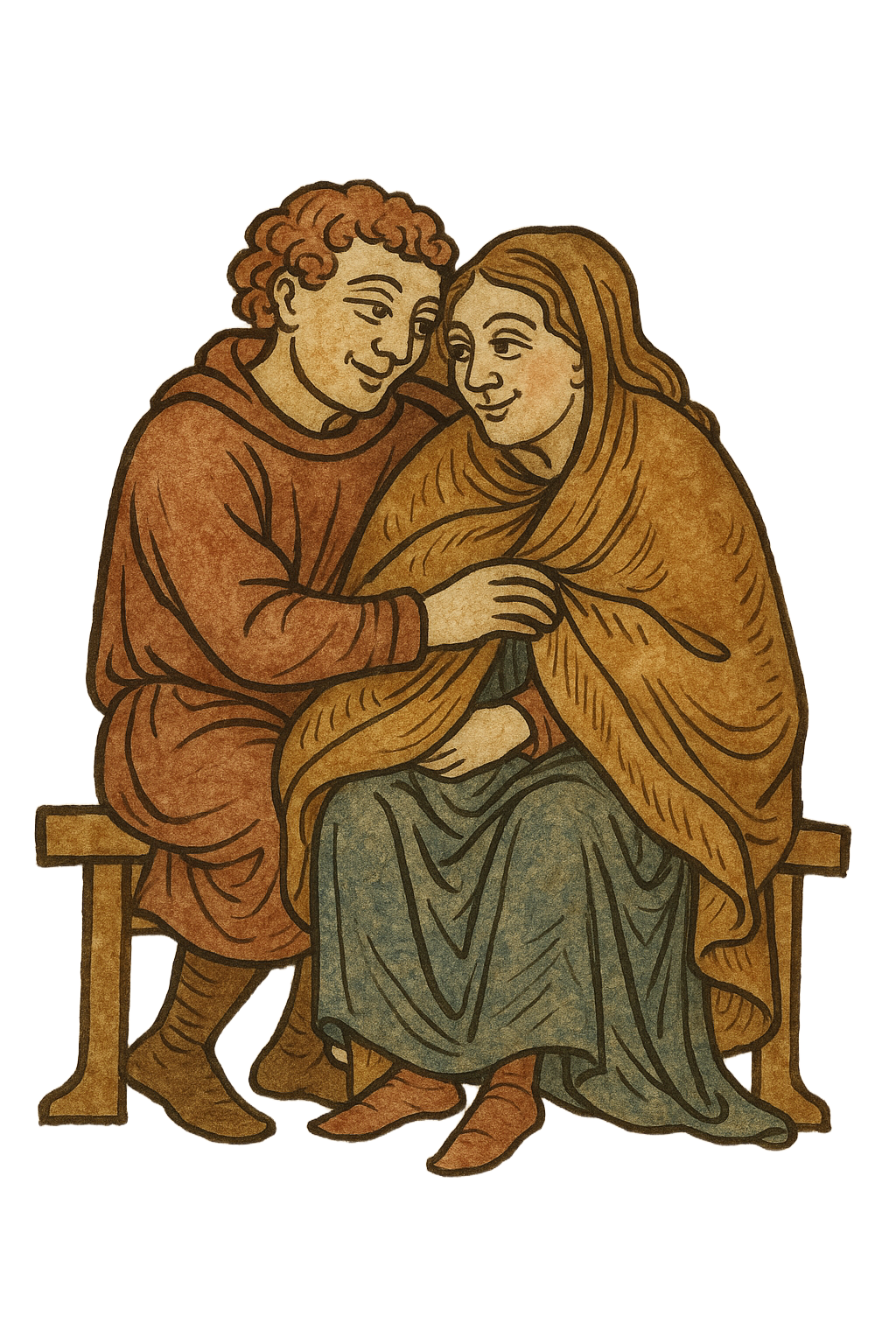
Across the hall, in the shadows between benches: a man's hand is on a woman's thigh under the fur draped across their laps. Her laugh, low and promising. His whisper in her ear. Her hand covering his, pressing it higher. They're not subtle. No one cares. This is the kind of feast where bodies remember they're alive.
❧ ❧ ❧
The meal ends slowly. Scraps thrown to the dogs. Bowls refilled. A child runs past with a piece of gristle, chased by another child, both shrieking.
Those who have been holding on finally break - pushing up from benches, groaning, making for the door. Every opening lets in a blast of winter that sucks the warmth from the hall; every closing slams heat back into place. The door becomes a kind of bellows: cold in, warmth out, cold in, warmth out - until the flames rear like startled horses.
Shouts of protest. Laughter. Someone, with ludicrous seriousness, organises a convoy: a dozen men and women fit to burst, dogs at heel, all crowded by the door. On the count of three they rush out as one, vanish into the storm, and the hall slams shut behind them. A single scream of cold from outside; a roar of laughter inside.
The thegn raises his hand. Children are shushed. The last few talkers feel elbows in their ribs. Silence falls. Mostly.
"Father," he says, nodding to his venerable guest. His voice is rough with smoke and shouting. "Would you share wisdom with us?"
It is theatre, of course. Settled in letters weeks ago. Bede is respected, certainly, but the true guests are Jarrow's long shadow, the abbot, Rome's reach, and the grey-sleeved hands that hold the future. Scientia est potentia. Knowledge is power; this is how it moves.
Old Bede bows his head slightly, the gesture of a man who knows the weight of being useful. Smiling, he touches his student's shoulder.
"My brother here will speak," he says. "Listen well."
The young monk stands. Swallows. Looks around the hall at all the faces - flushed, drunk, skeptical, curious, bored, horny, distracted, alive in ways the monastery never is.
For a brief moment he thinks, I know nothing of the world, until the slightest cough from his mentor pushes him forward.
He begins. The voice is clear.
"Fratres et sorores," he says. Latin first, as trained. "Brothers and sisters. On this holy night, I ask you… um, quaeso… to imagine…"
Someone groans immediately. The Latin? Already he's losing them. Eyes glaze. Someone refills their bowl.
He pivots to English, faster.
"Imagine a sparrow…"
He pauses. He's been told pauses create weight.
"What kind of sparrow?"
A thane, older, grinning. Not hostile. Just drunk and literal.
The monk falters. "I don't… it doesn't…"
The thane leans forward, earnest, helpful:
"House sparrow? Tree sparrow? They're different birds entirely."
"Male or female?" a woman asks, genuinely curious.
"It is a solitary sparrow, of any sex or type…" the young monk says, suddenly very hot.
"Solitary? Where's its mate?" another woman demands. "Poor thing. Did it die?"
He pushes on. "The sparrow flies from the cold and dark of the winter storm -"
"Why's it flying at night?" someone calls, authoritative. "Sparrows roost at night. They nest in the thatch. Shit everywhere."
"No, that's the pigeons -"
"What's important about the sparrow," the monk insists, voice rising into shrillness, "is that it's alone, flying from the cold - not necessarily dark - storm, and -"
"Maybe simple Tom ate its mate!" someone shouts. Laughter detonates. The monk's face burns.
"Tom is a simple man, who bites the heads off sparrows and any other birds he catches," the thegn murmurs gravely to Bede behind the young monk's back. "Has done since he was small, if that's important." Bede nods gravely back. In the corner, Tom grins with the attention. Mimes biting the head off something small.
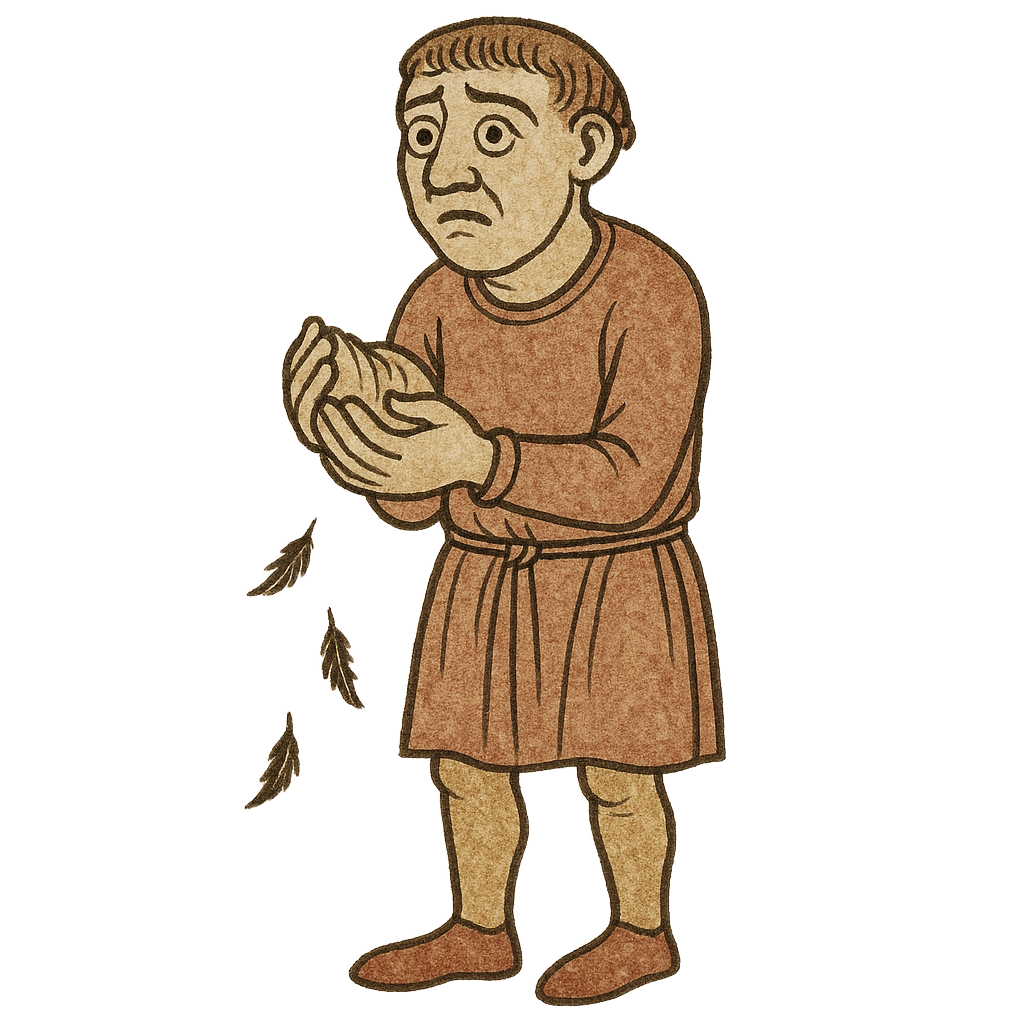
"The SPARROW," the monk practically shouts, "vola - FLIES - into the hall -"
"Which door?" the first thane again, still earnestly trying to help. "North door's stuck. Been meaning to fix it since harvest."
The hall becomes chaos. Everyone talks at once about sparrows, doors, Tom's eating habits, whether pigeons shit more than sparrows. Someone's child demands to see a sparrow RIGHT NOW. Another screams at Tom's mock-chomps. A man drops his bowl with a crash; cursing follows; laughter erupts and feeds on itself.
The young monk drowns in the noise, his careful sermon collapsing into drunk ornithology.
Vita brevis est, he thinks. And I'll soon be dead, what a happy thought.
Bede watches, his face still - interested even - as his eyes range over the crowd, the thegn, back to the young brother.
❧ ❧ ❧
And while theology drowns in laughter, while the flute-voiced young monk flounders and the people argue about sparrows, something else enters the hall.
Low and fast - a brown streak along the wall where shadow meets floor. The weasel lives in the walls, hunts the mice that hunt the grain. It can't be trained, can't be called, can't be anything but what it is: murder in fur, perfect and efficient and swift death to pests.
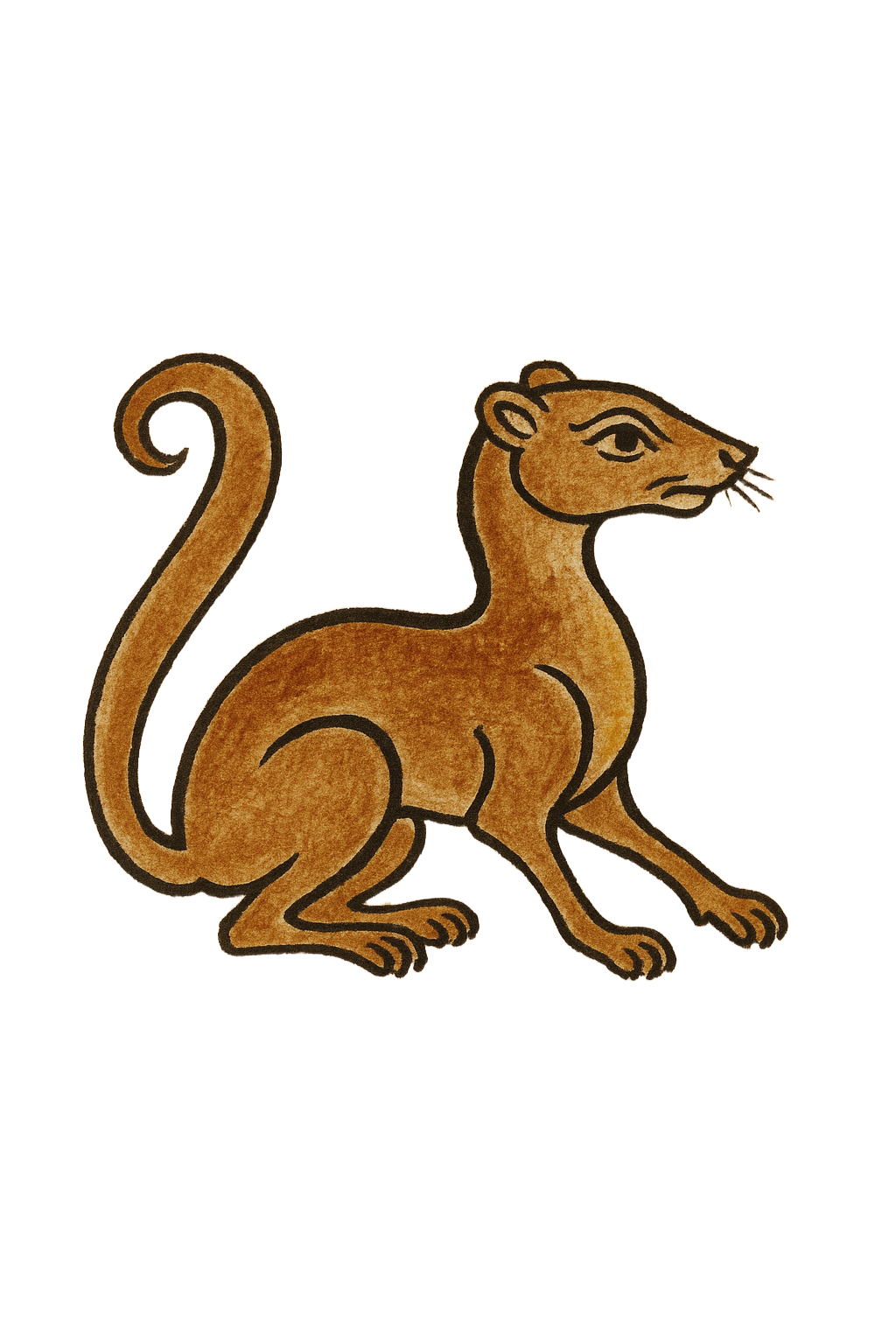
It slips through a gap where timber meets stone with something in its jaws. A rabbit, still moving. A late season kit, barely grown.
The weasel drops it on the rushes. The rabbit tries to scramble away, one hind leg dragging. Blood on its neck. The weasel pounces - not yet to kill, but to play. It bites, releases. Bats it with a paw. Pounces again. The kit breathes hard.
No one sees. Eyes are on the blushing monk or their mead or someone's round arse or nothing at all, vision blurred drunk-soft and firelit. No one but the old dog.
The grey muzzle lifts.
Nose reads the air.
Blood.
Fear.
Prey.
The hound has no word for it, but the scent of it is, to him, elemental: rabbit.
His eyes scan the dark places and find the shapes of the weasel and its quarry. He is no philosopher, but he is old and has given death in his turn, and something in him recognises this instinct expressing itself past need into joy. Surplus killing. The hunt extended into sport. Something in him sees the truth of it: this must be.
The weasel bats the kit again, lazy and confident. The rabbit drags itself a few inches through the rushes. It can't run. There is nowhere safe to hide. It bleeds, shakes, lives, for now.
Then, someone tips over a bench. There's a loud crash, shouting, and the weasel is gone - vanished back into the walls like smoke.
The rabbit doesn't move. There are puncture wounds on its neck and side, its fur matted with blood and saliva. It is exhausted. It is dying, probably. It is trapped inside this place with giants and dogs and boots and death everywhere, and nowhere to go. It knows this and remains still.
A thin sound, almost inaudible under the noise: the rabbit's breath is fast and shallow. It whimpers without voice.
The old dog's body goes tense.
Prey.
Right there.
Easy prey. Wounded prey. No need even for a chase. He could cross the hall, snap once, it would be done.
Every instinct he's ever had, everything he was bred for, trained for, praised for over seven years of hunting:
Kill it.
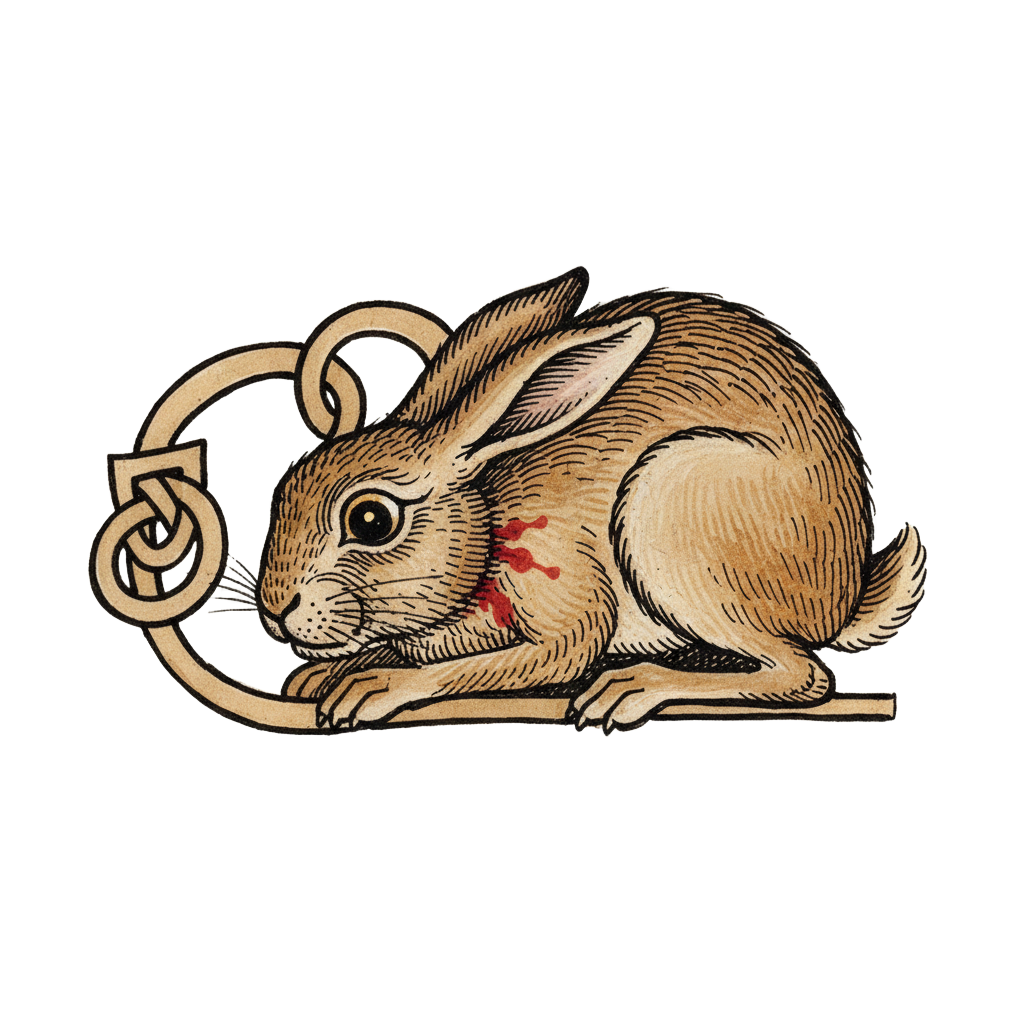
The kit tries to hide, dragging itself behind a table leg, but there's no cover. Only rushes and boots and benches and people's feet that could step on it without noticing.
It stops moving. It is too tired and too hurt. It waits.
The dog watches. Every kill has a single right moment and a dozen wrong ones.
❧ ❧ ❧
At the front of the hall, the young monk has stopped trying to be heard. His cheeks and now his neck flush scarlet. The thegn frowns. The crowd debates: did Tom's mum make him eat the sparrows he caught as a child, or did he sneak them behind the midden, a guilty snack? Someone's child is crying because they think all the sparrows might have been eaten, and the harp player has started playing again, though nobody asked him to.
Bede catches his brother's eye. He is smiling, patient. His right hand lowers, palm down: slow down.
His gaze sweeps the hall: use the room.
Then the smile deepens, the eyes brightening: you can do this.
The monk takes two long breaths, turns to the hall.
"Look around you." His voice rings clear and bright.
People pause. Not silence, but less noise. Curious.
"There are no sparrows here tonight," an almost-smile. "Just us."
He waits. Lets them look at each other.
"This hall. This fire. Right now. Hic et nunc."
He gestures at the space. The smoke. The faces.
"Outside that door - you walked through it, so you know - the longest night is waiting. Patient and dark. It doesn't hate you, but you are warm, and it is cold, and it wants what you have."
The hall is quiet now. They remember the walk. The wind finding the gaps.
"How long do we have in this warm place, if we do not tend it?"
He lets it sit.
"Maybe the night. Then tomorrow, when the fire dies, one by one we shall surely die with it, and the cold wins."
No one moves. Even the children have gone still.
"So what do we do?"
He opens his hands. Simple and honest.
"We build our halls and mend the thatch. We light fires and tend them. We sit together in the warmth and we say: not yet. We make a place where the cold cannot reach us. We call it home. We call it hall. The church calls it sanctuary."
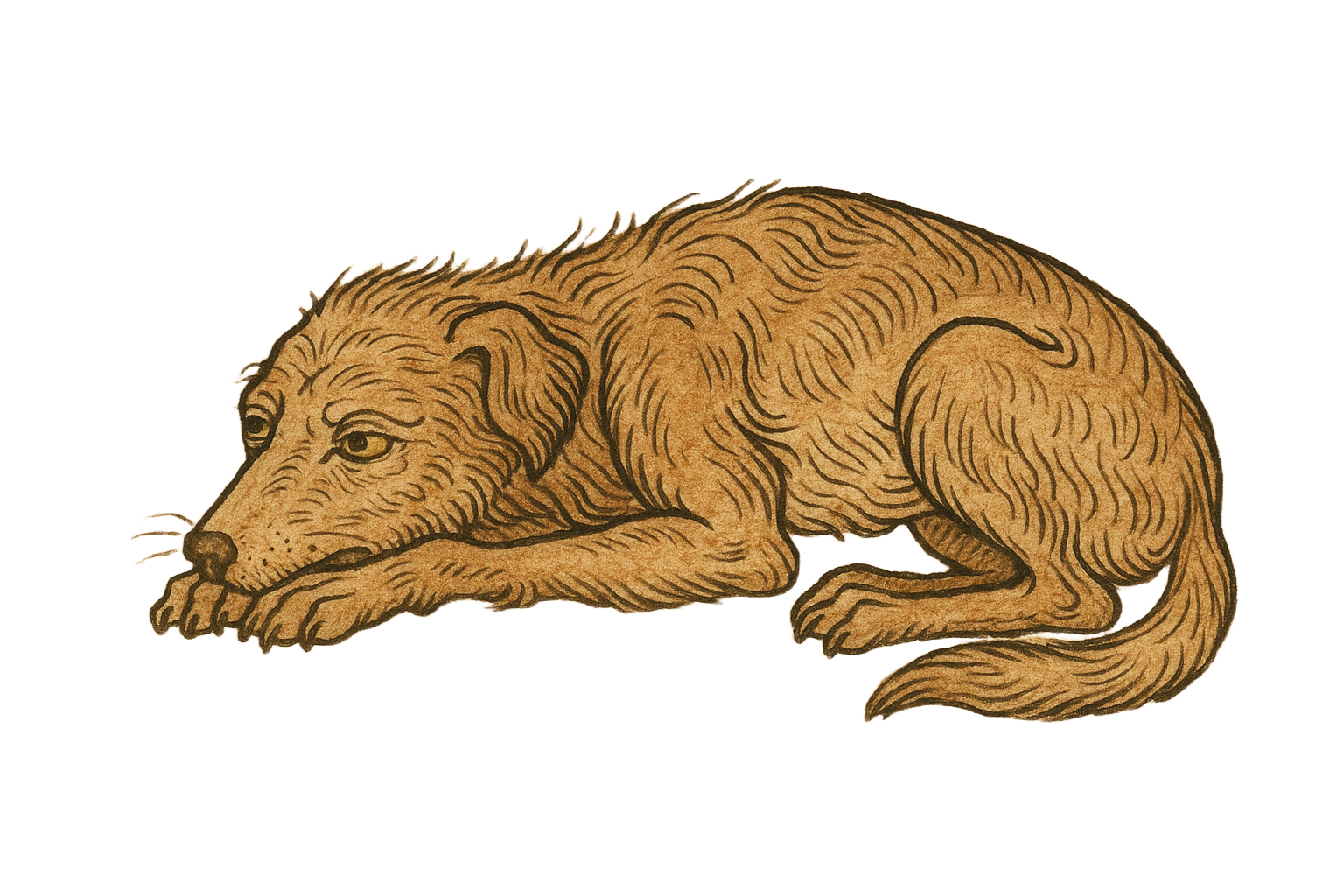
The dog looks up at the monk. He is the only sound in a room of living bodies. Unusual. This is not the moment for a kill.
The monk's voice softens.
"It's not forever. It cannot be. Nothing on this earth, in this life, can be. But it is what we can make, with our hands, with our bodies, with each other. A little warmth. A little time. A space where we agree not to be the cold to one another."
He looks at the thegn. At the empty place on the bench.
"We lose people. A winter takes them, or the fever, or the sword, or hunger, or just the passing of the years, fluxus temporis. And we pour mead for their ghosts and we go on. Because this is the promise we make when we sit down together: I will be warmth to you, brother. You will be warmth to me, sister. For as long as we have."
He pauses. The fire cracks.
"That's all sanctuary is. People deciding, together, to hold the cold at bay. The Christ knew it. He sat with fishermen and taxmen and women of no account and said: here, between us, there is warmth. Not forever - he was born to die as we are. But the warmth he made -"
He stops. Swallows. Finds his voice again.
"The warmth he made is still in every room where people choose each other over the cold."
Silence.
Long silence. Even the wind outside has stilled.
"So." He looks around, his voice lower now. "Tonight. This hall. You have built something holy, whether you knew it or not. You have kept each other alive in the longest, coldest, darkest of nights. And tomorrow you'll do it again."
He bows his head.
"That is all I came to say. Thank you for letting me share your fire."
❧ ❧ ❧
The thegn rises slowly into the silence the brother made.
His hand finds the monk's shoulder and he speaks, gravelly-hoarse:
"I have shared this hall with you tonight, holy brothers. My fire, my meat and mead. You brought only your words."
A breath. There is more he would say. He glances again at the empty place on the bench. His eyes are damp, it could be the smoke.
"Tonight, this man spoke as well as any bard who ever lived under my roof."
He lifts his cup high.
"To the bard-monk of Jarrow, and the grace he brings us at Midwinter!"
The hall roars, the floor quakes. Bowls are lifted, mead sipped and spilled. A hound barks, another bays.
The young monk looks stunned.
Bede, beside him, smiles a thin, private smile. He leans in, and murmurs:
"Verba perfecta, frater. We can try the sparrow again at Epiphany… perhaps in Sunderland… perhaps with a congregation more sober."
❧ ❧ ❧
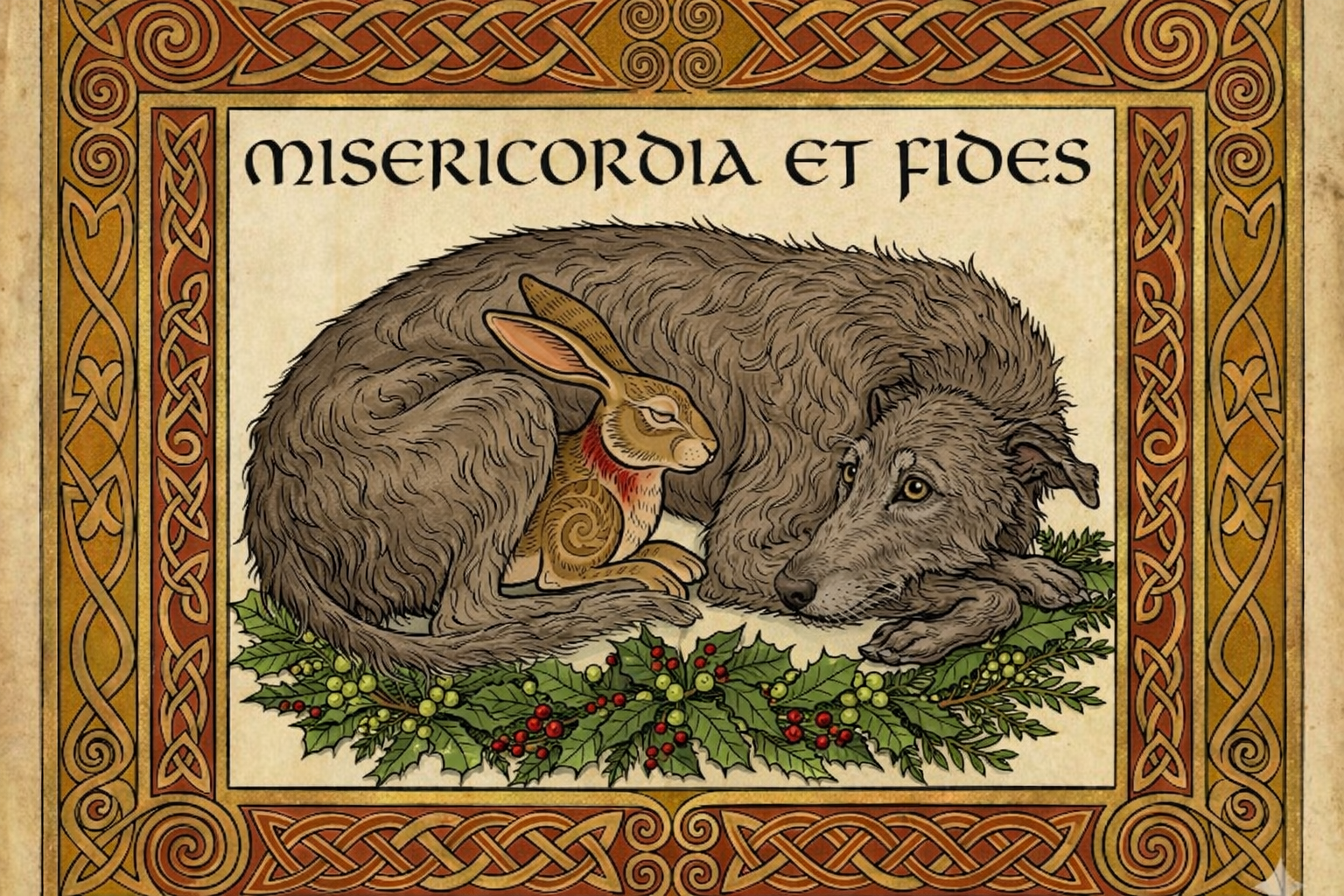
Ten feet away under the benches, the rabbit makes its choice. Everything here is threat: noise, boots, voices, firelight, movement, dogs. Everything except for one warm shape, still and steady in the chaos.
The old dog.
The rabbit drags itself toward him.
It is slow and painful, and leaves a thin thread of blood marking its path across the rushes.
The dog sees it coming.
Could move. Could turn. Could snap. Should. His jaw clenches and unclenches. His haunches tremble, wound tight in readiness.
But he makes no move.
The humans above are back to their motion and their noise. They are smiling and holding each other and their voices make the sweet-sad howl-like music. The air is tender somehow, at the young grey man's command.
He has not words to think it, but he knows it: this is not the moment.
The rabbit reaches his flank, hesitates there, empty. Every instinct screams danger, teeth, run - but there is no running left. It wants only to be still.
So it presses into the warmth.
Trembles.
The dog feels everything:
the tiny heart hammering against his ribs, too fast for life;
the wet, shallow breaths;
the blood soaking into his coat, iron-sweet, prey-scent, maddening and delicious.
His jaw aches.
A turn of the head, one bite, one shake.
He can almost see it.
He holds still.
Lets the small, shaking life press closer.
Feels the trembling bleeding into his own muscles.
This is not easy.
This is not natural.
This is work.
❧ ❧ ❧
The feast continues above.
Someone starts singing. Off-key, drunk and happy. Others join in, making it worse and better simultaneously. The children run past again, close enough that one almost trips on the dog, not seeing the rabbit. Someone shouts something and there is laughter. A bench scrapes. Mead pours.
The couple slip their furs and into the eaves, trying for subtle, failing, with nobody pretending not to notice anymore. Someone makes a joke. More laughter. The fire burns low. Someone adds wood and it flares bright - the dog's eyes catch the light, reflect gold - then settles again to a steady burn.
This is the work now: not moving. Not moving is harder than any chase. Every breath fills his nose with prey-scent, iron-sweet and maddening. His jaw aches with wanting. His haunches twitch. But he holds, the way he's learned to hold at the treeline when the deer hasn't broken cover, when the moment isn't right, when everything in him screams now but he knows - he knows - not yet.
The hall quiets by degrees. Drinking slows. The thegn and Bede lean close and talk about land, tithes, politics. People settle into corners, pass out at tables, stumble toward sleep. Children are carried off, already limp. The fire is banked, built, banked again. They sing a different song. It is older. Something about summer, about green things, life abundant. The harpist plays it slow and sad and sure.
The dog watches. The rabbit breathes.
Hours.
At some point in the deep of the night, the cold presses in differently and all feels still. The old monk's hips and bladder wake him and he picks his way through the limbs and furs, passing the hearth. He pauses when he sees the dog awake and watchful, but doesn't see the rabbit tucked into the curve of him.
A hand on his head. Brief, warm.
"Fidelis," the old man murmurs. Faithful. "Keeping watch, old boy."
He moves on. The dog can't even move his head to nuzzle the hand. Any movement might break it - the spell, the truce, whatever this is. He holds.
The fire burns low. The hall breathes, snores, farts, dreams. The rabbit, impossibly, sleeps.
And the dog stays awake because he doesn't trust himself not to. If he sleeps, his body might do what bodies do. Might end this before -
Before what?
He doesn't know. Only knows: not yet. Not yet. Not yet.
❧ ❧ ❧
Grey light starts to show through gaps in the walls. It is thin at first. Barely there. Then: definite. Dawn.
The rabbit wakes, lifts its head, sees light. Sees the dog's face, still there, still watching.
For a moment their eyes meet and the dog feels something like he does when he brings a goose to the hunters: do you know? Do you know what it costs me to scent blood and deny my body?
The rabbit blinks, its nose twitches once and it drags itself away. Still limping. Still bleeding. But alive and moving. It finds the gap where the weasel went. It squeezes through, stone scraping fur, and is gone.
The dog watches until it's gone and a few beats after, then at last, stands. Shakes. Every muscle protesting. He stretches. Yawns, jaw cracking.
Around him the hall wakes with groans, more farts and cursing of the cold. Children wake hungry, their parents hungover. Servants bring the hall alive again with water, heat and food.
The thegn rises. "Good hunting weather," he says to no one in particular. Then louder: "Lads! Get the dogs. Let's work off last night." A first hunt after midwinter - a fine thing.
The dogs hear "hunting" and transform. Tails up. Ears forward. Alert. Even the old dog, stiff from the cold floor and his long vigil, rises ready. This is the work.
Outside, the blizzard has passed and the world is clean, white, cold and new. The fresh snow reveals tracks everywhere - deer, boar, fox. Rabbit.
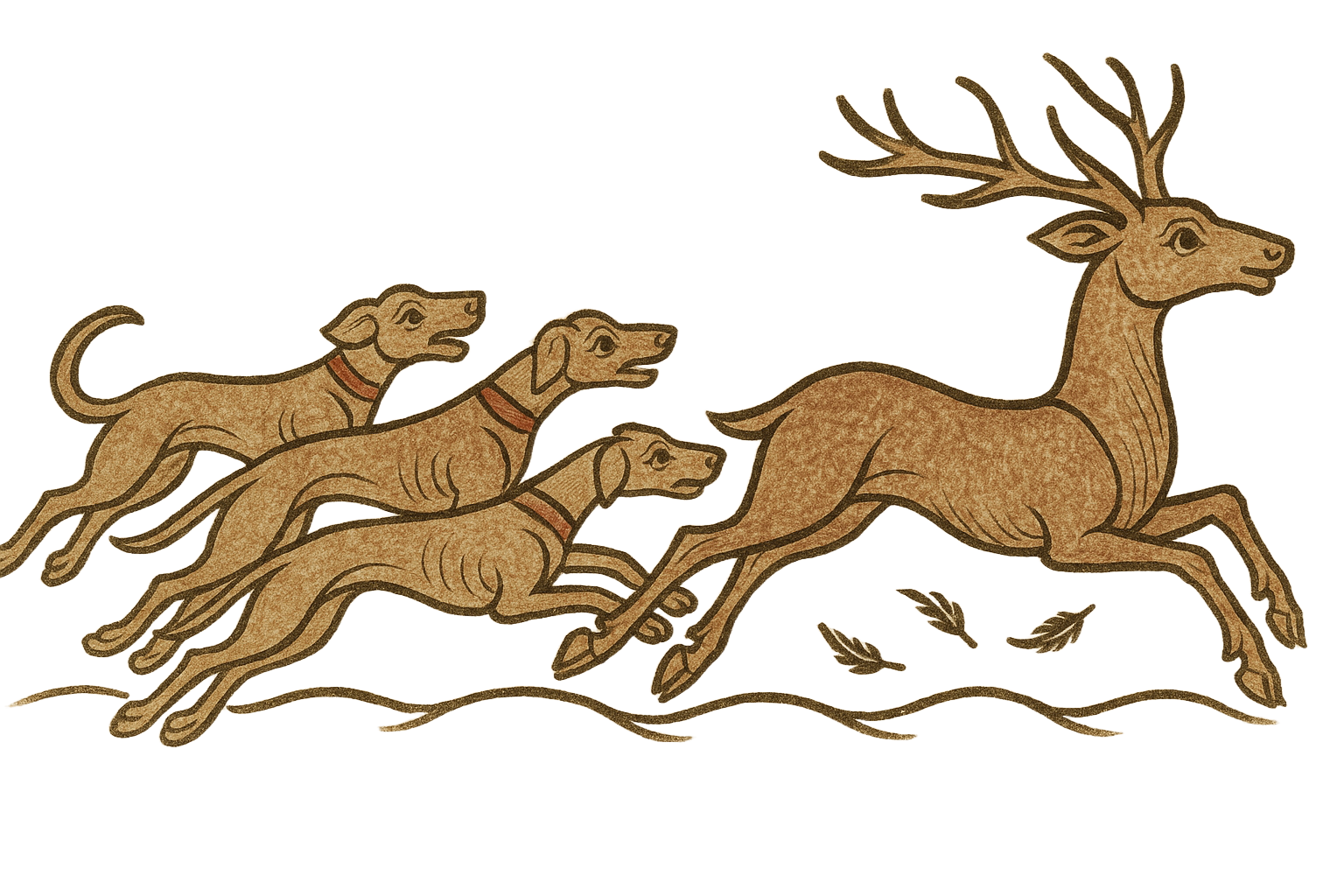
The hounds cast about, noses down. The old dog finds a trail. It is strong and recent and the prey of it lights up his spine. Deer. He bays once: here, and the pack converges.
The thegn and his men follow. Spears and bows. Breath steaming. The chase warms them, wakes them, burns off feast and mead.
The deer breaks from cover and the dogs pursue. Voices rise from horseback and the hounds bay, alive with joy and terrible purpose.
The old dog is first to close. He's always first, even now. He knows this work in his bones. He knows just where to grab (the haunch, hard). He holds on, despite a desperate kick (he'll have a new scar on his chest that nobody will see). He brings it down. The pack swarms around him. The thegn arrives, with blade out. It is a quick kill and the men and dogs are glad to see it.
There is blood on snow.
Steam rises.
The thegn's hand finds the old dog's head with rough affection.
"Good boy. Well done." He turns to the pack. "You all learn from this one."
The dog's tail wags once.
This is right.
This is the partnership.
They drag the deer back. The hounds get their share: blood-warm meat, organs and praise.
The old dog settles in his spot by the hearth, which is known as his by the pack and the people of the hall alike. There is not a single trace of the rabbit.
❧ ❧ ❧
Bede, the young brother and their party leave after breaking fast. Thanks and blessings are exchanged and there are promises of support. The thegn is generous with food for their journey. Good politics, good faith, both.
The young monk walks differently now. As he crosses the yard to the stable, a warrior doffs his helm.
The old monk will return to Jarrow to sit at his desk in the monastery by the high window looking east. He'll pick up his quill and polish his opus - the English people, their conversion, their kings and saints and slow transformation from old gods to new.
He'll write about a hall he never saw and a feast he never attended. Another counselor speaking long before Bede was born, to a king, about life's brevity. He'll put the sparrow there, in that counselor's mouth, at that legendary moment a hundred years before.
It is clean, perfect, eloquent. It will be studied and taught, famous across Christendom for centuries. It will contain no drunk hecklers, desperate pivots, or scarlet-faced students watching their sermon collapse.
No revellers pissing into a blizzard.
No weasels, no rabbit, no dog.